Marianna Martines

Marianna Martines

Sinfonia in C Major (Overture)

Harpsichord Concerto in E Major

Marianna wrote the Sinfonia in C Major in 1770 (the year Beethoven was born) at age 26. It has been a delight to get to know more about Marianna and her fabulous compositions this year.

Marianna Martines left a significant amount of music including over 200 secular vocal works, sacred vocal works, three sonatas for keyboard, three concertos for keyboard, and the Sinfonia in C Major for orchestra.

Marianna spent her entire career in Vienna. Born May 4, 1744 to Nicolò and Maria Theresia di Martines, to was raised in the Michaelerhaus and lived in a six-room apartment on the third floor (a middle floor apartment where members of the middle class resided) above the Princess Maria Octavia Esterházy.

Viennese court poet Pietro Metastasio lived with the Martines family and was responsible for educating the Martines children in the languages of Italian, French, English, and in music. It was clear that Marianna possessed considerable talent in music. Auspiciously, Metastasio was aware of a very bright, and then unknown, keyboard instructor - Joseph Haydn, who happened to live in the attic room of Michaelerhaus. Pietro arranged free board for Haydn in the exchange of daily lessons for Marianna for three years.

As a young woman, Marianna was admired for her musical talent and was invited to perform in the finest homes in Vienna. Charles Burney came to Vienna in 1772, where he was introduced to Martines and Metastasio. Burney’s description of Martines on her singing, keyboard and compositional abilities are flattering and most interesting:

Sunday 6th. [With Metastasio] The discourse then became general and miscellaneous, till the arrival of a young lady, who was received by the whole company with great respect. She was well dressed, and had a very elegant appearance…. After the high encomiums bestowed by the Abbate Taruffi on the talents of this young lady, I was very desirous of hearing and conversing with her; and Metastasio was soon so obliging as to propose her sitting down to the harpsichord, which she immediately did, in a graceful manner, without the parade of diffidence, or the trouble of importunity. Her performance indeed surpassed all that I had been made to expect. She sung two airs of her own composition, to words, of Metastasio, which she accompanied on the harpsichord, in a very judicious and masterly manner; and, in playing the ritornels, I could discover a very brilliant finger….

Her voice and manner of singing, both delighted and astonished me! I can readily subscribe to what Metastasio says, that it is a style of singing which no longer subsists elsewhere, as it requires too much pains and patience for modern professors.

(Women Composers Music Through the Ages, p. 70)

It is interesting to think that when Martines was 29 years old, she met Mozart for the first time. Singer Michael Kelly wrote that “Martines was a favorite of Mozart and witnessed that Mozart was an almost constant attendant at her weekly musical parties. Kelly further stated that he had heard Mozart play duets of his own composition on the pianoforte with Martines.” (Women Composers Music Through the Ages, p. 70)

Following the death of her father, Martines moved from the Michaelerhaus and lived with her brother Joseph and sister Antonia. She continued her dedication to the arts. Marianna established a singing school and continued to arranged musical events open to all in the musical society until her death at age 68 from tuberculosis.

For more information on Marianna please see:

A Modern Reveal - Marianna Martines

Encyclopedia of World Biography - Marianna Martines

Marianna Martines - A Woman Composer in the Vienna of Mozart and Haydn

by Irving Godt and Edited by John A. Rice


Music you should know! June 2019

composers june 2019 (1).jpg

June 2019 has been a great month of listening. My goal this summer is to listen to music that I will be performing this next year and music that is new to me. As the summer goes on, I will write a little about some of the awesome composers I have discovered. For today, I am sending my June list with links to compositions. It is a thrill to share these amazing composers with you. Please send me your recommendations for listening. I would LOVE to hear your suggestions.

Bacewicz, Grazyna (1909 – 1969)

Bacewicz, Grazyna (1909 – 1969)

Beethoven, Ludwig van (1770-1827)

Beethoven, Ludwig van (1770-1827)

Beethoven, Ludwig van (1770-1827)

Chin, Unsuk (1961 - )

Chin, Unsuk (1961 - )

Coleridge- Taylor, Samuel (1875 - 1912)

Dawson, William Levi (1899-1990)

Garrop, Stacy

Gipps, Ruth (1921 – 1999)

Grant Still, William (1895-1978)

Grant Still, William (1895-1978)

Grant Still, William (1895-1978)

Grant Still, William (1895-1978)

Holmes, Augusta (1847 – 1903)

Holmes, Augusta (1847-1903)

Holmes, Augusta (1847-1903)

Long, Zhou (1953 - )

Maconchy, Elizabeth (1907 – 1994)

Maconchy, Elizabeth (1907 – 1994)

Mägi, Ester (1922 - )

Mägi, Ester (1922 - )

Mayer, Emilie Luise Friderica (1812-1883)

Mayer, Emilie Luise Friderica (1812-1883)

Mayer, Emilie Luise Friderica (1812-1883)

Newman, Maria (1962 - )

Newman, Maria (1962 - )

Newman, Maria (1962 - )

Newman, Maria (1962 - )

Newman, Maria (1962 - )

Price. Florence (1887 – 1953)

Price. Florence (1887 – 1953)

Price. Florence (1887 – 1953)

Price. Florence (1887 – 1953)

Sibelius, Jean (1865 - 1957)

Walker, George (1922 – 2018)

Walker, George (1922 – 2018)

Walker, George (1922 – 2018)

Weill, Kurt (1900 – 1950)

Weill, Kurt (1900 – 1950)

Weill, Kurt (1900 – 1950)

Wolfe, Julia (1958 - )

Yi, Chen (1953 - )

Journey of making change

My journey of making change starts today.

After organizing my office and beginning the mammoth undertaking of sifting through files, I happened upon some lectures from this past year. It is clear that now is the time to begin my summer resolution of musical blogging of the subject I find captivating - Gender.

Gender in the world of classical music is not an earth-shattering topic, but I find the subject absolutely fascinating and necessary! My goal for this blog is to be an excellent resource for those who may be interested in learning something new about gender, or those who may want to join a conversation concerning some of today’s hot topics in classical music – specifically concerning gender.

For a thought provoking visual exercise, imagine your ideal day as an orchestral musician. Let your imagination run wild.

You show up in the music hall of your dreams in order to play with the symphony you most admire. While finding your seat in your section, you begin having an entertaining conversation with your section mate about the new and improved therapeutic posture chairs. Your seatmate is debating whether the cost to the orchestra budget was worth it as the old chairs were “just fine.”

The stage manager quiets the orchestra to discuss a few symphony business items and is followed by the concertmaster standing to tune the orchestra. This is the 3rd candidate this year for the open concertmaster position. You pause to consider the past two applicants. The oboe plays the 440 A. Woodwinds begins the tuning process followed by the brass and then strings.

As the maestro steps up to the podium, you scan and catalog orchestra performers. There are several new faces. Baton is lifted and you look at the face of the conductor.

Rehearsal order starts with the overture, world premiere, and then concerto. After the break is the programmed masterwork symphony. You think to yourself, “thank goodness I have played it a few times.”

Voila! Three hours later, one more music gig accomplished. Oh! But wait…this is where I come in.

In the image you visualized, which musicians did you picture throughout the sections? Who was/were the concertmaster/s? Maestro? Principal players? Which compositions did your imaginary orchestra perform? What was the make up of your imaginary orchestra?

Did you find it equitable?

It is my goal is to address and acknowledge what is our cultures current norm.

Over the summer months, my plan is to offer some information that will hopefully stretch your thinking and more importantly, give you some listening and/or performing suggestions of outstanding music that you may have never heard. I hope you will enjoy.

I leave you with my article Gender disparity in music: A commitment and a conversation written for the fabulous folks at the Women’s Philharmonic Advocacy (See below)

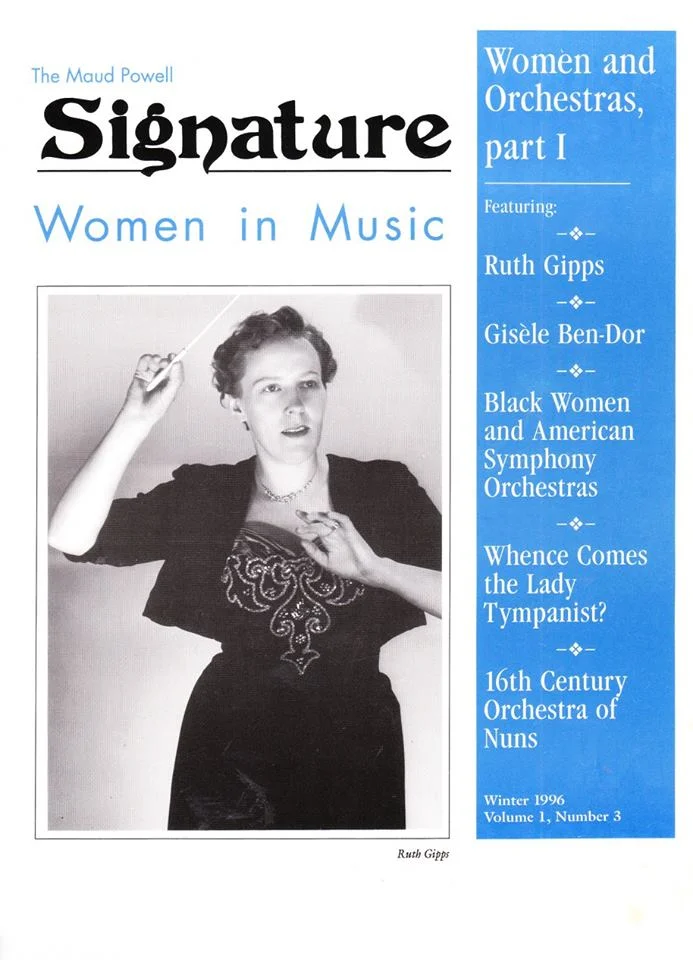
And, one of my favorite new finds - Ruth Gipps (1921-1999): Symphony No. 2 (1945)

(I will write more on Ruth Gipps soon...)

(I will write more on Ruth Gipps soon...)

Thanks for reading!