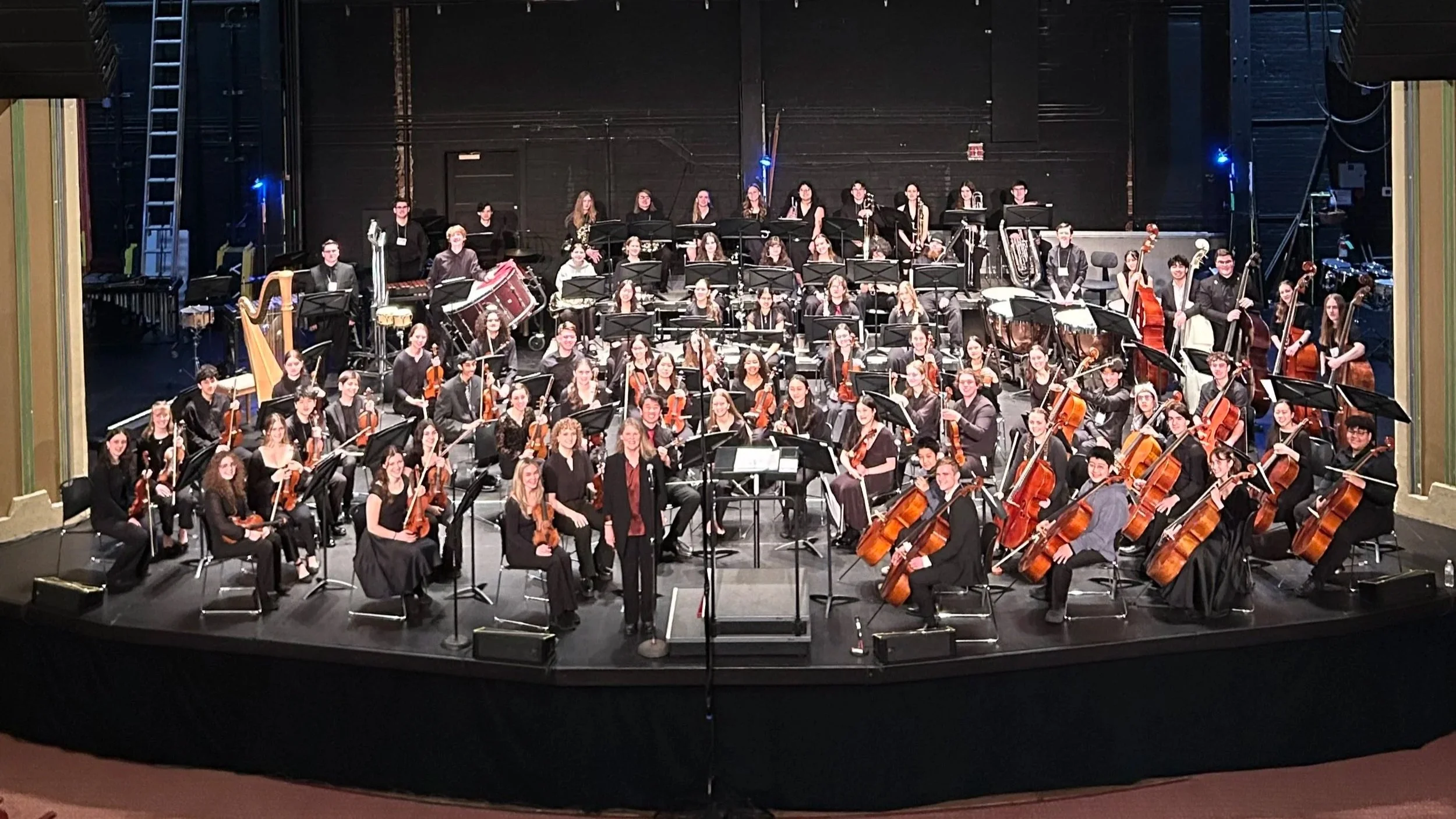
The Ripple Effect Starts Here: A Week with the New Hampshire All-State Orchestra
I wanted to share a glimpse into this last week (April 2026) with the New Hampshire All-State Orchestra students.
It was a fantastic week—full of hard work, intensity, great music, and overwhelmingly positive attitudes. But more than anything, it was a powerful reminder: we are surrounded by extraordinary young people who are going to do meaningful, impactful things in this world. I, for one, cannot wait to see how they shape it.
Before I go further, a quick pause.
I’ve been trying to step away from social media lately. To be more present. To connect more deeply with people and spend less time on my phone. And yet—here I am, writing a long post. That is because sometimes there are moments that feel too important not to share.
This week was one of those moments.
The Music—and What It Represents
The students performed a vibrant and compelling program featuring Nancy Galbraith’s Euphonic Blues and Samuel Coleridge-Taylor’s The Bamboula—music that is both joyful and deeply rooted in history and expression.
Students played with commitment, curiosity, and heart. But what struck me most wasn’t just the performance. It was everything that happened along the way.
What Music Education Actually Builds
Music teachers—here in New Hampshire and across the country—are doing extraordinary work.
They bring together numerous students, each with different instruments, different voices, different backgrounds, different levels of experience, and ask them to work toward a shared goal: creating something meaningful together.
And in that process, something remarkable happens.
Students learn to:
Collaborate and communicate
Take risks and make mistakes—and grow from them
Develop confidence through preparation and performance
Make fast, nuanced decisions
Listen deeply—to themselves, their stand partner, their section, and the full ensemble
Translate visual information into physical action
Refine incredibly precise motor skills
Balance independence with collective responsibility
They learn the language of music—tone, color, dynamics, intonation—but they also learn something far more important: They learn how to belong.
The rehearsal space becomes a place of inclusion. A place where students are seen. A place where they are challenged, supported, and given the opportunity to grow—not just as musicians, but as people.
And yes—they are quite literally building thousands of new neural pathways along the way.
Why This Matters—and Why These Moments Cannot Go Unnoticed
We as musicians have a responsibility—and an opportunity.
We DO make a difference in our communities. But we don’t always say it out loud.
We should.
Every rehearsal. Every concert. Every program.
We should consistently be asking ourselves: What are we doing for our community?
And then we should be telling that story—clearly, proudly, and often.
Because it matters.
The Ripple Effect Is Real
I had a wonderful conversation this week with Andrea von Oeyen (Oyster River H.S. Orchestra), Sam Lyons (Timberlane Regional H.S. Orchestra), Carrie Young (Oyster River M.S. Orchestra), Laura Swarce (Nottingham K - 8) about the idea that real change doesn’t always come from large, abstract systems.
It comes from focusing on the communities right in front of us.
The students in our rehearsal rooms.
The families who are part of our school systems.
The schools and neighborhoods we serve.
When we invest deeply in those spaces, the impact doesn’t stay contained.
It ripples outward.
It reaches more students.
It creates more access.
It opens doors for those who might otherwise never have the opportunity.
And those students go on to create their own ripple effects.
Intention Isn’t Enough
This week also reaffirmed something I’ve been thinking about a lot:
Intention only works when it is supported by strong, clear infrastructure.
If we want to build something meaningful—something lasting—we have to create the systems that support it.
Because without that foundation, even the best intentions will struggle to take hold.
But, when the structure is there? That is when real, lasting change becomes possible.
Think Globally. Act Locally.
I keep coming back to the words Scottish biologist and urban planner Patrick Geddes coined concerning how to work incrementally with the environment: Think globally. Act locally.
If we pay attention to our communities—truly invest in them—we can make a difference.
Not in some abstract, distant way, but in real, tangible, human ways.
In rehearsal rooms.
On stages.
In the lives of students who are still discovering what they are capable of.
And that’s what I saw this week.
A room full of young musicians—learning, striving, collaborating, and creating something beautiful together.
That’s where it starts.
That’s where the ripple begins.
And it is worth everything.